Your cart is empty
Continue Shopping
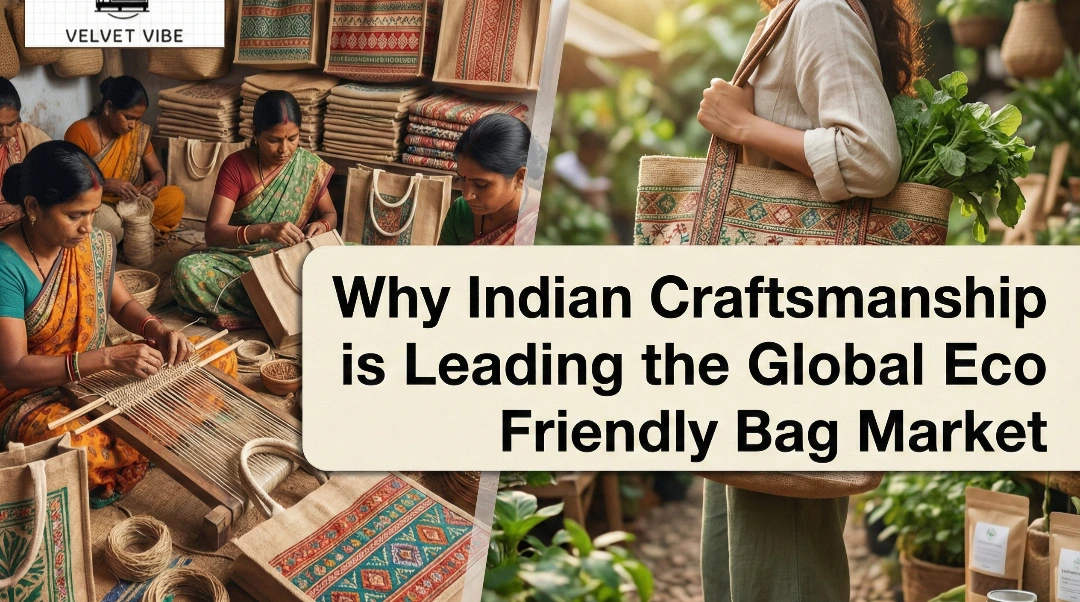
Something unusual is happening in plain sight. Walk into a supermarket, a boutique store, or even an airport shop, and you’ll notice it — plastic bags fading into the background, replaced by textured, earthy alternatives. Pick one up, and there’s a good chance you’ll find a quiet mark of origin: Made in India. This is not a coincidence. It is a shift — subtle, steady, and global. Indian craftsmanship, once seen purely as tradition, is now influencing how the world thinks about sustainability, durability, and responsible production.
But why India? And why now?
Across more than 60 countries, plastic restrictions are tightening. Businesses are racing to find materials that are biodegradable, scalable, and cost-efficient. At the same time, consumer behavior is changing faster than ever — 72% of global consumers now say they are willing to pay more for sustainable products. Supply chains are being rebuilt around circular economy models, natural fibers, and ethical sourcing. And at the center of this transition sits a craft ecosystem that has quietly worked with nature for generations.
The scale of this shift is impossible to ignore. The global eco-friendly bag market, valued at USD 3.5 billion in 2024, is projected to reach USD 10.2 billion by 2033, growing at a CAGR of 12.5%. Behind these numbers lies a deeper story — one shaped by heritage, innovation, policy, exports, and changing global priorities. India is not just participating in this movement; it is helping define it.
In this article, you’ll discover:
Keep reading — because this isn’t just about bags. It’s about how tradition, responsibility, and smart innovation are reshaping a global industry right now.
Long before sustainability became a global buzzword, Indian artisans were already working with nature. The rough yet elegant texture of a handwoven bag, the resilience of natural fibers, and the understated beauty of plant-based dyes tell a story synthetic materials rarely match.
India has long relied on jute, organic cotton, and hemp — renewable resources that are biodegradable, low-impact, and supportive of rural livelihoods. Natural dyeing and hand-weaving techniques significantly reduce chemical pollution and carbon emissions, while modern water-efficient processing has further improved sustainability.
Jute, in particular, naturally decomposes without leaving toxic residues, aligning perfectly with circular economy principles and supporting biodiversity in cultivation zones. These qualities define India’s leadership in natural fiber bags, biodegradable bags, sustainable textiles, eco-conscious materials, and even regenerative agriculture practices.
Unlike mass-produced alternatives, handcrafted Indian bags emphasize durability and meaning. Reinforced stitching, dense weaving, and thoughtful construction make these bags long-lasting — a crucial but often overlooked sustainability factor.
Ethical labor practices, including fair wages and artisan empowerment, add another layer of value. Handmade authenticity, often verified by artisan cooperatives, resonates deeply with global consumers, 61% of whom now consider climate impact in purchasing decisions.
In real-world usage, durability frequently outweighs recyclability. A well-crafted reusable bag reduces consumption cycles dramatically — proving that true sustainability often begins with longevity.
The Asia-Pacific region holds roughly 20% of the global sustainable bag market, with India playing a major role due to its strong export ecosystem and rising domestic adoption.
India’s sustainable packaging market reached USD 10.23 billion in 2025 and is expected to grow to USD 17.73 billion by 2034. Investments in biodegradable research and development — exceeding INR 2,500 crores — are accelerating innovation across natural materials and eco-packaging solutions.
India now commands 37.6% share in household eco-bags, reflecting strong everyday adoption. Segment-wise, cotton bags continue expanding globally with a focus on organic and recycled variants. Meanwhile, jute remains dominant — India’s jute bag market alone reached USD 135 million in 2025, forming a 34.8% share, while the global jute bag industry approached USD 2.68 billion.
This growth is not purely demand-driven. Infrastructure, policy support, and traceability technologies — including blockchain-enabled sourcing — are strengthening India’s position as a scalable and reliable sustainable manufacturing hub.
India is the world’s largest jute producer, generating over 1.8 million tons annually, primarily from regions like West Bengal. This abundant supply gives India a significant competitive edge in Indian jute bag exports.
The jute bags market reached USD 300.12 million in 2024, growing steadily with a projected CAGR of 4.52%, while the global market is expected to cross USD 2.95 billion by 2026. Jute’s natural strength, reusability, and biodegradability make it ideal for eco-packaging — especially considering its relatively low water footprint compared to other fibers.
Global plastic restrictions are accelerating demand for eco-friendly bags. Over 63 countries now enforce Extended Producer Responsibility (EPR) regulations, encouraging biodegradable alternatives.
India’s supportive policies include mandatory jute packaging for food grains and sugar, nationwide single-use plastic bans, and waste-reduction initiatives under Swachh Bharat Mission 2.0. Globally, even regions like California are tightening plastic regulations, boosting demand for sustainable imports.
Market share across eco-bag materials between 2024–2026 reflects this trend:
International brands are increasingly sourcing from India — drawn by compliance, cost efficiency, and traceable production enabled by emerging digital systems.
Indian eco-friendly bags are no longer just handcrafted — they are technologically enhanced. Modern production integrates AI-driven design optimization, sustainable supply chain mapping, and efficiency-driven manufacturing, allowing traditional skills to meet contemporary global expectations without compromising authenticity.
Innovations include:
Across India, even heritage-driven workshops are evolving through mindful innovation. Many manufacturers are gradually adopting low-waste production practices and durability-focused craftsmanship, reflecting how traditional skillsets are adapting to modern sustainability expectations without losing authenticity. Some long-established producers, including Pruthi Shoppers Pesrur, have quietly embraced durability-focused construction and low-waste practices — demonstrating how sustainability today is less about replacing tradition and more about refining it.
Even after logistics and export costs, India maintains a strong cost advantage, supported by improved infrastructure such as regional plastic and packaging parks and increasingly efficient supply chains.
Today, India competes on value, sustainability, and craftsmanship — not merely price. Premium positioning of handcrafted eco-products continues to gain global traction, strengthening the role of Indian manufacturers as reliable partners in the global shift toward responsible production.
Sustainability now directly shapes purchasing behavior. Around 67% of global consumers prioritize sustainability in accessories, while 72% are willing to pay more for eco-friendly products. In India, 68% of consumers regularly use reusable bags, and 36% consider non-plastic packaging the most environmentally responsible.
Gen Z, in particular, is reshaping consumption — nearly 30% actively avoid fast fashion, favoring durable, ethical products.
Plastic bans continue driving biodegradable adoption, especially across Asia, where packaging alternatives are growing at nearly 13.87% CAGR. Global sustainability awareness is projected to expand markets significantly over the coming decade.
E-commerce and quick-commerce platforms are also shifting toward biodegradable packaging — creating new export opportunities for Indian manufacturers.
Modern eco-friendly bags are evolving into multi-functional lifestyle products. Trends include:
Sustainability is increasingly becoming a measurable, verifiable feature rather than a marketing claim.
Eco-friendly bag production in India supports millions of livelihoods. The jute sector alone employs over 4 million people, many in rural and women-led communities.
Handcrafted production reduces carbon intensity compared to fully automated systems and promotes equitable economic participation. Ethical sourcing strengthens brand credibility globally and aligns with the UN Sustainable Development Goals.
Sustainability, in this sense, is not just environmental — it is socio-economic. It fosters resilience, supports communities, and builds long-term value chains grounded in responsibility.
Choosing an eco-friendly bag is not just about replacing plastic — it is about selecting a product that genuinely reduces environmental impact over time. The right choice balances durability, material science, usability, and long-term sustainability rather than short-term convenience.
Not all eco-friendly bags serve the same purpose. A grocery bag carrying heavy produce requires different strength than a lightweight lifestyle tote or retail packaging bag. Travel and daily-carry bags may need reinforced bases, multi-compartment design, and moisture resistance.
Look for:
A well-chosen bag used consistently for years creates far less environmental impact than frequently replacing lower-quality alternatives.
Material choice determines environmental footprint, durability, and end-of-life impact. Understanding fiber behavior helps make better decisions.
Whenever possible, avoid virgin synthetic materials. Prioritize biodegradable, renewable, and low-impact fibers that minimize long-term environmental harm.
True sustainability is verifiable. Certifications ensure that materials, production processes, and environmental claims meet recognized standards.
Look for:
Transparency in sourcing and production helps identify genuine eco-friendly products and prevents greenwashing — a growing concern in sustainable markets.
The environmental value of a bag lies in how long it lasts. A single durable reusable bag can replace hundreds — sometimes thousands — of disposable plastic bags over its lifetime.
Consider:
Lifecycle sustainability often matters more than upfront cost. The longer a bag stays in use, the lower its environmental footprint becomes.
Sustainability works best when practicality meets usability. While eco-friendly bags may carry a slightly higher initial cost, long-term reuse significantly reduces overall expense. Many retailers now encourage reusable bags through incentives and discounts.
Style also plays a psychological role. A well-designed, visually appealing bag is more likely to be reused regularly, increasing its environmental value. Function, aesthetics, and durability together create real sustainability — not just a symbolic shift.
Finally, remember: the most sustainable bag is often the one you already own. Reusing before replacing remains the simplest and most impactful step toward conscious consumption.
India is poised to maintain dominance in natural fiber eco-bags, potentially holding 60% of the global jute market. Key growth drivers include sustainable material innovation, expanding environmental regulations, and rising eco-consciousness worldwide.
The next phase will likely focus on branding, premium sustainable design, and digital market positioning — moving beyond volume exports toward value-driven global leadership.
India is steadily transforming into a global hub for sustainable manufacturing, supplying both mass and premium eco-friendly markets.
Indian craftsmanship represents a rare convergence of tradition, sustainability, and scalability. The rise of eco-friendly bags is driven by supportive policy frameworks, growing consumer demand for verified sustainability, continuous material innovation, and ethical production systems.
Sustainability today feels less like a trend and more like a structural shift — and India stands firmly at its center.
Within this evolving landscape, manufacturers that combine genuine craftsmanship with reliability and consistency naturally stand apart. Businesses seeking durable, ethically produced, and globally relevant eco-friendly bags increasingly look toward trusted suppliers rooted in India’s craft heritage. Among them, Pruthi Shoppers reflects the very qualities shaping this industry — long-standing craftsmanship, dependable quality, and products designed for real-world durability and sustainable value.
Choosing eco-friendly bags today is no longer just about replacing plastic — it is about supporting responsible production, long-term usability, and meaningful craftsmanship. The shift toward reusable, sustainable choices begins with conscious decisions — and continues with partners who understand both craft and purpose.
What makes Indian eco-friendly bags globally competitive?
The combination of sustainable materials, skilled craftsmanship, cost efficiency, and strong export infrastructure makes India a leading global supplier.
Are jute bags truly biodegradable?
Yes. Jute is a natural fiber that decomposes naturally within months under suitable environmental conditions.
Why is India leading in eco-friendly bag exports?
Abundant raw materials, supportive policies, plastic bans, and strong alignment with global sustainability demand contribute to India’s leadership.
How do I verify if a bag is genuinely eco-friendly?
Check materials, certifications, biodegradability claims, and supply chain transparency.
Are eco-friendly bags more expensive?
Initial costs may be higher, but long-term reuse makes them more economical than disposable alternatives.
Which material is best for sustainable reusable bags?
Jute and organic cotton are among the most durable and environmentally friendly, with hemp emerging as a strong alternative.
Developed & Maintained by Era Sky Technologies in partnership with Exporters Worlds © 2026 All Rights Reserved
Enquire Now